
I want to begin by acknowledging the tragic terrorist attack on Bondi Beach on Sunday, 14 December and recognising the profound distress it has caused within the Jewish community, the first responders, bystanders, families, as well as the broader Australian community. As we grieve, we acknowledge with gratitude the hospital staff involved, many of whom would be RACP Fellows and trainees.
At this time, we extend our sincere wishes for peace, healing and safety, for all those affected, directly or indirectly by this tragedy.
____________________________________________________________________________________
This is my first end-of-year post as PCHD President, and while this year has seen its share of challenges, I’m very proud of all that has been accomplished by our committees and Paediatrics & Child Health Division trainees and Fellows. The work being done in the PCHD Division is at its heart aiming to influence the systems in which we train and work as paediatricians. It has been a privilege to be involved and lead this work across the Division. Here is a snapshot of some of the work being done.
Last month I travelled to Sydney to present as part of the Australasian Society for Developmental Paediatrics (ASDP) Private Practice Workshop. It was a very full, very successful day, and to ensure I give this the coverage it deserves, I encourage you to read more in the standalone item below this President’s Message.
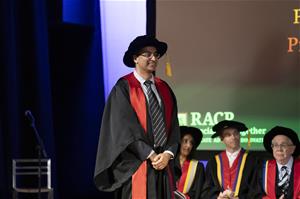
I am very grateful to my predecessor, Professor Nitin Kapur for stepping in to welcome some 40 of our new paediatric Fellows, as I was unable to attend the Convocation held at the Brisbane Convention & Exhibition Centre on Saturday, 1 November. Welcome to you, and to all of our new Fellows who joined our paediatric membership in 2025.
The Thriving Kids initiative aims to transform how early intervention is delivered to children aged 0-8 years with mild to moderate developmental delays, and has the potential to have a significant impact on improving the development and wellbeing of Australia’s children into the future. The design of this system will have a crucial impact on the health of Australia’s children and on the paediatric workforce, and I have welcomed the opportunity to be closely involved as it develops. The RACP provided a submission to the inquiry and we continue to actively engage in discussions with Professor Frank Oberklaid AM, who co-chairs the Thriving Kids Advisory Group, with Health Minister Mark Butler MP, as well as our paediatric specialty societies: Australasian Society for Developmental Paediatrics and Academy of Child and Adolescent Health, as well as the Murdoch Children's Research Institute.
I was recently invited to attend two ‘deep dive’ sessions with the Thriving Kids Advisory Group and key stakeholders to discuss service principles to underpin a model for Thriving Kids, and to discuss the implications for the paediatric workforce both currently and into the future.
PCHD President-elect Dr Paul Hotton and Policy & Advocacy staff also recently attended a workshop exploring important design elements, potential intended and unintended consequences of Thriving Kids, how the program should be implemented, what factors are necessary for success, and what information/data is needed to evaluate the program.
I have been impressed with the level of consultation with paediatricians and the RACP and I’m hopeful that the delivery of the program continues to engage with paediatricians, whose work is so closely involved in this. It is anticipated that a plan with recommendations will be provided to Minister Butler before the end of the year for consideration, so I will keep you updated as more information becomes available.
ADHD reforms continue to evolve across the states and territories. Following the RACP ADHD roundtable held on 25 August (see our September newsletter for more information) correspondence to the federal and all state and territory health ministers was distributed with responses from all jurisdictions. I have since had productive meetings with either the Health Minister or Chief Medical Officer/Chief Health Officer in Queensland, the Northern Territory, Tasmania, New South Wales, South Australia and Western Australia. The ACT will be held in coming weeks, with the federal government and Victoria scheduled for the new year. The PCHD and Policy & Advocacy team are refining a national proposal for ADHD management, emphasising the need for safe, shared care of ADHD and the role of paediatricians and adolescent and young adult medicine physicians, with release scheduled in the new year.
MBS reform is an area of major concern to paediatricians and the RACP has heard this feedback from members. I’m pleased to share that work on paediatric MBS items is now well underway. PCHD, through its Policy & Advocacy Committee (PPAC), has developed an MBS proposal urging reform to reflect the realities of modern paediatric care. This comes at an important time with changes to MBS items that took effect on 1 November. Physicians now have greater flexibility to use telephone consultations for ongoing patients, expanding access to physician care for those who can’t attend in person or via video. Additionally, we have shared our draft MBS plan with Frank Oberklaid, so that the MBS items relating to developmental conditions is considered by the Thriving Kids Advisory Group.
These changes highlight both the opportunities and ongoing challenges in ensuring paediatricians are supported to deliver timely, equitable, and high-quality care for children and young people. PPAC will continue to lead the paediatric work, working with our paediatric specialty societies, to drive ongoing engagement with the Department of Health, Disability and Ageing, and the Minister for Health. Our shared goal is to ensure paediatric MBS items reflect the complexities and realities of modern practice and support the sustainability of paediatric services across Australia.
I am glad to draw your attention to an important new RACP bi-national position statement: Social Media – Children/Tamariki and Young people/rangatahi recently published. This document calls on both the Australian and Aotearoa New Zealand governments to ensure that social media platforms are responsible for creating safer online environments for children/tamariki and young people/rangatahi and maintaining safe online environments as these individuals grow into adulthood.
The release of this new statement is very timely considering the introduction of the Australian Government’s legislation on social media platform access for under 16-year-olds on 10 December. Our RACP statement is available on the RACP website and PCHD President-elect Dr Paul Hotton, our spokesperson on this matter, has been quoted in a recent Health Services Daily article ‘Let’s be sensible about a social media ban: RACP’ and Croakey Health article ‘The Zap: latest health and aged care news, plus consultations and inquiries now open’. Also, on 10 December I was interviewed about the social media ban by 2GB – you can listen to that interview via their website.
Many of you will be aware that I am a member of the International Pediatric Association (IPA) Standing Committee, and the Asia Pacific Pediatric Association (APPA) Oceania Representative. I am proud to represent both the RACP and Australia on these international bodies. As part of my IPA representation I have recently been appointed as the Coordinator for the IPA Program Area on Early Childhood Development, which encompasses three key sub-areas: early childhood development (ECD), childhood disabilities, and primary care.
We are undertaking a global survey of paediatricians to better understand current practices in these areas; the findings are expected to provide valuable insights and guide future international priorities. I am fortunate to be working alongside an exceptional group of dedicated and passionate paediatricians from around the world. I recently had the opportunity to present a webinar for the IPA on the Science of Early Childhood Development.
I would like to extend an invitation to paediatric members who are interested in becoming involved in the program area – your expertise and participation would be greatly valued. If anyone is interested in participating in any of the programs, please don’t hesitate to contact me via Paed@racp.edu.au.
It gives me great pleasure to highlight the nomination of Professor Nadia Badawi for NSW Australian of the Year 2026. Professor Badawi is a paediatric Fellow of this College in the specialty of neonatal/perinatal medicine, and it is in this capacity she is being celebrated with this nomination. Described by the Australian of the Year Awards website as a “pioneering neonatologist”, she is praised for her work in “helping thousands of critically ill newborns survive and live healthy lives through her work as co-head of the Grace Centre for Newborn Care at The Children’s Hospital, Westmead”. The nomination also references her services as Chair of Research with Cerebral Palsy Alliance (CPA). That website states: “Nadia is an innovative neonatologist and co-head of the Grace Centre for Newborn Care at The Children’s Hospital at Westmead, where under her leadership, survival rates for critically ill newborns exceed 96%, among the best in the world”. Professor Badawi is clearly a very deserving nominee for this prestigious award, and we are proud to call her one of our own. We extend our warmest congratulations for her nomination and our thanks for her continuing exemplary service.
The holiday season will soon be with us and I want to thank you for any and all contributions you’ve made to our Division and College this year. Thank you for continuing to learn and to teach, for your contributions to advocacy work, or any other way that you support this membership organisation of ours. It has been a challenging year, a long year, and your steadfast commitment and support have not gone unnoticed. That said, please try to take some time to rest and refresh, to spend time with loved ones, and to look after yourselves and each other. My very best wishes to you for a safe and happy holiday.
Dr Niroshini Kennedy
PCHD President
Pomegranate Health podcast: Your contributions welcome
The RACP podcast, Pomegranate Health, has published over 100 episodes since starting out ten years ago.
To provide more frequent and focused content we’re seeking contributions from our speciality societies, committees and affiliated professional organisations.
You already spend considerable time preparing lectures and webinars for your colleagues. Audio podcasts provide an easy way to reach thousands more around the world.
Each episode gets downloaded around 6500 times over the first 12 months from publication, with 21 per cent of listeners located outside of Australia and Aotearoa New Zealand.
All you need to do is to organise one or more presenters and an interviewer familiar with the material. The podcast producer will coordinate an online recording lasting about one hour and then edit it down before publication. The intention would be to ‘brand’ regular episodes from your specialty society or organisation.
Please send any questions or ideas to podcast@racp.edu.au